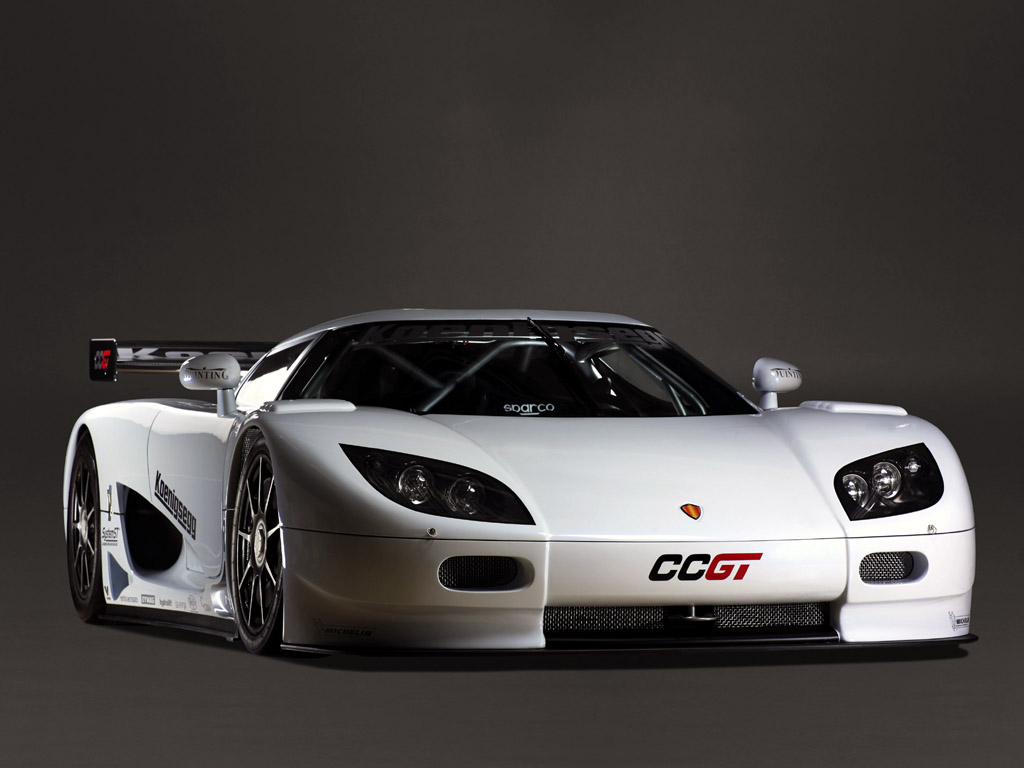
Koenigsegg CCXR

Koenigsegg CCXR

The Koenigsegg CCXR is a mid-engined roadster from Swedish car manufacturer Koenigsegg. The Koenigsegg CCXR is powered by a modified twin-supercharged V8 engine from its predecessor the CCX, converted to use E85 or E100 ethanol fuel as well as standard 98 octane petrol. Besides the use of ethanol fuel, Koenigsegg CCXR only changes to the engine are modified fuel injectors, upgraded fuel lines and piston rings and a higher boost setting on the superchargers.
The increased power of the Koenigsegg CCXR, compared to the CCX, is a result of the cooling properties of ethanol in the engine's combustion chambers allowing for a higher pressure in the cylinder and the biofuel having a higher octane rating of 113 RON compared to 95 RON for gasoline in North America and 100 RON for gasoline in Europe.Koenigsegg says that it will go 271 mph (436 km/h), making it theoretically the fastest production car in the world.The designer of the Koenigsegg CCXR, and founder of Koenigsegg, Christian von Koenigsegg is quoted as saying, "Our engineers couldn't quite believe the figures when we tested the car".
Koenigsegg CCXR

Performance of the Koenigsegg CCXR Edition can accelerate from 0–100 km/h (62 mph) in 2.9 seconds and from 0–200 km/h (120 mph) in 8.9 seconds.[citation needed] The Koenigsegg CCXR can accelerate from 0–200 km/h (120 mph), then decelerate from 200 (120mph)–0km/h, in 13.7 seconds. According to Koenigsegg, the estimated top speed of the Koenigsegg CCXR is 400+ km/h (250+ mph), although this has not been officially verified. The braking distance of the Koenigsegg CCXR is 32 m (when decelerating from 100 km/h (62 mph))
The Koenigsegg CCXR engine is a 4.7 litre 288 cu in (4,719 cc) V8, with dual overhead camshafts and 4 valves per cylinder. The engine block is made of Aluminium alloy that has undergone a T7 heat treatment, a form of accelerated precipitation strengthening. Koenigsegg CCXR the engine has a compression ratio of 8.8:1, is boosted by two Rotrex centrifugal superchargers that provide 1.6 bar of boost, having a patented response charge system for optimal engine response, and is injected by a sequential multipoint fuel injection system. The engine of Koenigsegg CCXR is lubricated with a dry sump system with a separate oil pump, the pistons are cooled by oil sprayed onto them and the oil itself has an external cooler.
The Koenigsegg CCXR engine produces 1,064 bhp (793 kW; 1,079 PS) at 7200 rpm and 782 lb·ft (1,060 N·m) of torque at 6100 rpm on E100 ethanol fuel. The CCX engine burns 18 L/100 km (16 mpg-imp; 13 mpg-US) on highway travel and 22 L/100 km (13 mpg-imp; 11 mpg-US) on combined travel on E85 ethanol fuel.
Koenigsegg CCXR

The Koenigsegg CCXR is a two-door, two-seater with a removable hardtop that can be stored under the front hood lid allowing it to be changed at any location. Koenigsegg CCXR body, made of pre-impregnated carbon fiber and Kevlar with lightweight sandwich reinforcements, is 169 in (4,300 mm) long, 78.6 in (2,000 mm) wide and 44.1 in (1,120 mm) tall with a ground clearance of 3.94 in (100 mm).
The Koenigsegg CCXR has a frontal area of 1.867 m2 (2,894 sq in) and a drag coefficient of 0.33. The drag area (frontal area times drag coefficient) is 0.61611 m2 (954.97 sq in). It also has a flat underside with venturi tunnels at the rear and an optional rear spoiler to improve aerodynamics. At 250 km/h (160 mph) there is 100kg of downforce.The Koenigsegg CCXR has a specially developed transversal six speed manual gearbox with an optional paddle-shift with a dual plate clutch of diameter 240 mm.The power is fed to the rear wheels through a torque sensitive, limited slip differential. The gear ratios of the Koenigsegg CCXR can be seen in the table below.


courtesy by http://en.wikipedia.org/wiki/Koenigsegg_CCXR