Showing posts with label drive. Show all posts

AUDI Q7


 AUDI Q7

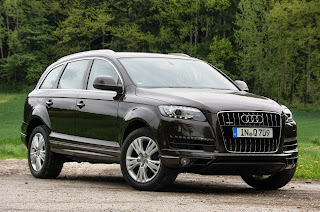
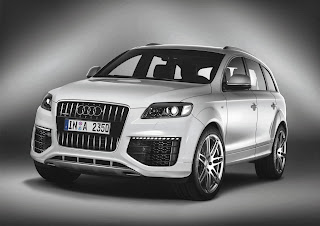
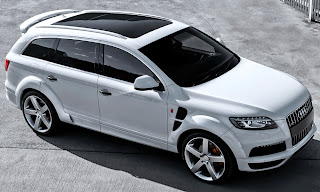
The 2014 Audi Q7 must not be broken, because Audi sure isn't in a hurry to fix it. Believe it or not, the three-row Audi Q7 is still basically the same crossover that first reached our shores in 2007, even though its platform-mates from Porsche (the Cayenne) and Volkswagen (the Touareg) have since moved on to second-generation designs. "Broken" would be a strong word for the Audi Q7 anyway, as good fundamentals plus numerous updates over the years have kept it in the hunt among seven-passenger luxury crossover Audi Q7 SUVs. Nonetheless, it's hard for us to recommend Audi's venerable SUV given the strength of its newer competition.

One category in which the Audi Q7 remains competitive is performance. On the gasoline-powered side, the
Audi Q7 supercharged 3.0T V6 is smooth and capable, and it's offered in a 333-horsepower state of tune in case the standard 280-hp rating seems insufficient. On the diesel side, the recently updated TDI V6 moves the Audi Q7 with authority, and it gets 28 highway mpg to boot. Both are paired with an excellent eight-speed automatic, and all Audi Q7  are surprisingly rewarding to drive, somehow managing to impart an athletic feel despite their imposing dimensions.

AUDI Q7

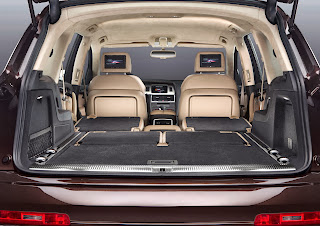
But the Audi Q7 has some drawbacks in regard to practicality that can only be rectified by a full redesign. Chief among them is the Audi Q7 s lack of interior space. Despite having a larger footprint than its main competitors, the Audi Q7 ranks below average for cargo capacity and passenger room in the third row. Furthermore, the Audi Q7 is pretty heavy, and that drags down fuel economy to the point that you have to get the pricier diesel if you want respectable mpg.In these respects, the Audi Q7's advancing age is unmistakable, and newer alternatives will likely serve you better. To wit, the Land Rover LR4 and Mercedes-Benz GL-Class offer roomier cabins with adult-friendly third rows, while the Acura MDX delivers more space and better gas-powered fuel economy at a lower price. The same could be said of the Infiniti QX60, which can also be had as a hybrid. Then, there's the BMW X5, which is closest in spirit to the Q7, but thoroughly updated for the 2014 model year.If you find yourself coming back to the 2014 Audi Q7  though, we can't blame you, because even after all these years, it's still a pretty nice ride. There are certainly things that could be better, though, and we'd advise you to consider all your options before going with Audi's large crossover.The 2014 Audi Q7 is a full-size, seven-passenger luxury Audi Q7 SUV offered in three trim levels: 3.0T Premium, TDI Premium and 3.0T S line Prestige.

AUDI Q7

Audi Q7 comes standard with 18-inch alloy wheels, adaptive xenon headlights, LED running lights and turn signals, rear parking sensors, roof rails, a power liftgate (with programmable opening angle), heated mirrors, automatic wipers, dual-zone automatic climate control, leather upholstery, Audi Q7 eight-way power heated front seats (with four-way lumbar), a manual tilt-and-telescoping steering wheel, a sliding and reclining 40/20/40-split second-row seat and an auto-dimming rearview mirror.Audi Q7  technology features include Bluetooth phone connectivity and an 11-speaker sound system with a CD player, satellite radio and an iPod interface. The Audi Q7  TDI Premium gets 19-inch wheels and additional exterior chrome trim.Opting for the Premium Plus package (with either engine) adds a panoramic sunroof, a rearview camera, front parking sensors,Audi Q7 auto-dimming and power-folding exterior mirrors, keyless entry/ignition, a power tilt-and-telescoping steering wheel, driver memory functions, Audi's Multi Media Interface (MMI) with a 7-inch display screen, Audi Q7 Connect (enhanced Web-based navigation, information and WiFi access), a navigation system with voice control and a 14-speaker Bose surround-sound audio system with HD radio.The 3.0T S line Prestige includes the above equipment and adds 20-inch wheels, special exterior styling details, a blind-spot warning system, ventilated front seats and the Warm Weather package (optional on Premium Plus), which includes a deep-tint panoramic sunroof, four-zone automatic climate control and manual sunshades for the rear doors and tailgate.The S line Prestige's extra features can be added to the TDI via an essentially identical Prestige option package. Other options for Prestige-equipped Audi Q7  include an adaptive air suspension, 21-inch wheels, adaptive cruise control, a corner-view camera system, a 14-speaker Bang & Olufsen surround-sound system and an S line interior trim package.Some features offered on upper trim levels are available on lower trims. Optional on all trims are rear side airbags, a rear-seat entertainment system, a Towing package and a Cold Weather package, which adds heated rear seats and a heated steering wheel.



courtesy by http://www.edmunds.com

Mclaren F1


Mclaren F1


The Mclaren F1 is more than a hedonistic plaything. We knew already that it was the fastest, most powerful road car we were ever likely to test: Jonathan Palmer’s 231mph at Nardo had put the  Mclaren F1 firmly on pole for straight-line speed. We knew it was the most expensive, too at £540,000, nothoing else gets close for outrageous extravagance. That the  Mclaren F1 was the lightest, least compromised of the great modern supercars was ancient history. And that it embraced the Gospel according to Murray was engraved in stone, too. It took a talented team to put the  Mclaren F1 on the road, but Murray is the driving force behind it. The  Mclaren F1 is his car, his dream, his achievement.We knew all these things and much, much


BMW X6


more. What we didn’t know was what the  Mclaren F1 was like to drive. No-one outside the company bar a few prospective customers had driven an  Mclaren F1  never mind driven one in anger. CAR – who else? – would be the first to do so.There would be no demonstration run, no inhibiting company minder, no strings other than to sign a rather frightening indemnity. My brief was to be at  Mclaren F1 pristine Woking headquarters by 8am, have Jonathan Palmer, McLaren’s marketing director, show me around the car, and then get it and go. Destination: Wales, via a circuitous route that would take in several favourite roads. God, it’s a hard life.

Mclaren F1

My departure was delayed by a small technical hitch with XP5, the fifth  Mclaren F1 prototype which is representative of customer cars dynamically, but not in finish. While the snag was sorted, I boned up again on the car’s targets and design.To dismiss the  Mclaren F1 as a rich man’s toy is to sell it short. Compromise was not in Murray’s script. Perfection and cutting-edge technology were. Murray’s 10-hour concept brief in 1990 to the close-knit team charged with the task of developing the first  Mclaren F1 Road car has already passed into motoring folklore.  Mclaren F1 provide the ultimate uncorrupted driving experience, Murray decreed a three-seater, with the driver in the middle, sitting well forward as in a racer. Anything that diminished driver pleasure, the car’s raison d’etre, was out. Mclaren F1 definitive adrenaline pump would have minimal front and rear overhangs, and all its masses – engine, transmission, fuel, occupants, luggage – would be contained well within the ‘dumb-bell’ weight distribution. Low moments of inertia, regardless of load, were essential. So were low centre of gravity and light weight.Murray is obsessed by weight. His ambitious target of 1000kg (2200lb) – which was nearly achieved – meant compact dimensions and ruthless paring. Not for the  Mclaren F1 masterpiece the gross obesity of a Jaguar XJ220 or Testarossa, both of which weigh hundreds of kilogrammes more. It also dictated Formula One carbon-composite construction for the immensely strong body/chassis unit. That a test driver escaped unscathed from a high speed crash in an  Mclaren F1 prototype is testimony to the monocoque’s integrity and strength.

Mclaren F1

Packaging was key to the  Mclaren F1success. Get that right and the rest would fall into place. Fashion would have little to do with the car’s timeless styling. Ground-effect aerodynamics  Mclaren F1 cab-forward driving position, spinal air-intakes…these and other considerations dictated how designer Peter Stevens would shape the car. Another Murray edict that raised eyebrows was that there would be no turbo motor. Only the linear delivery of a big, high-revving, normally-aspirated engine would do for a car that was to be the fastest in the world, and civilised with it. Mclaren F1 talked to several engine manufacturers before accepting BMW Motorsport’s proposal to build a 6.1 litre 60-degree quad-can V12. Awesome though it is, this purpose-built 48-valve powerhouse, which yields considerably more torque than a Formula One engine (more than 479lb ft from 4000-7000rpm), draws heavily on existing BMW technology: variable valve timing from the M3 six, for instance. Dry-sump lubrication that reduces the depth of the crankcase squared with the quest for a low centre of gravity. Mclaren F1 drive to the rear wheels is through a slimline six-speed gearbox. There’s no traction control, for that would diminish driver involvement, not to mention add weight.  Mclaren F1  have ditto power steering, anti-lock brakes, and adaptive damping. There’s not even a servo to assist the Italian Brembo brakes – huge, cross-drilled ventilated discs clamped by four-pot callipers. Nothing has been allowed to diminish the tactile relationship between man and machine.


courtesy by http://www.carmagazine.co.uk

BMW X6


BMW X6


BMW X6


The 2012 BMW X6 ranks 18 out of 18 Luxury Midsize SUVs. This ranking is based on our analysis of 40 published reviews and test drives of the BMW X6, and our analysis of reliability and safety data.
Though reviewers love driving the 2012 BMW X6, they question its purpose. It’s a high-performance SUV with a sports-car price tag and limited utility.

Reviewers can’t figure out what type of vehicle the BMW X6 is, but after driving it, they’ve decided that they don’t care, and call it one of the best-handling, most fun-to-drive SUVs on the market. However, the auto press emphasizes that those looking for practicality or value should look elsewhere. “We set out to determine what the BMW X6 is, and this is our answer: BMW X6 a fully capable, beautifully finished, and superbly comfortable four-place sports car with a trunk big enough for almost any adventure and the ability to tow up to three tons of what won’t fit inside,” writes Car and Driver.

BMW X6

The BMW X6 is a vehicle reviewers love, but consumers may have a hard time justifying a $60,000 purchase. Though its base trim costs $11,700 more than the BMW X5, it has less cargo space and can seat only four (a fifth seat was added as a $350 option this year). The BMW X6’s suspension is tuned tightly to make it sporty, but some reviewers say that makes it uncomfortable as a daily driver. The ActiveHybrid X6 adds $30,000 to the base price and makes 100 more horsepower than the base BMW X6, but it gets worse fuel economy than the base model. And the BMW X6’s 2.5-ton curb weight cuts down on any fuel economy that could have resulted from the turbocharged, direct-injected six-cylinder engine.
But, if you’re in the market for a fun-to-drive SUV with loads of interior amenities and aren’t constrained by a budget, reviewers say you won’t find anything better than the BMW X6. It takes corners like a pro, and the upgraded V8 engine blasts it to 60 mph in 5.2 seconds. Plus, it comes stuffed to the gills with standard features like front and rear parking sensors, a power liftgate, leather upholstery and adaptive cruise control. To some shoppers, the BMW X6 will make no sense at all, but to others, it’s an ideal combination of track star and people-hauler.

BMW X6


If you’re in the market for a practical SUV, the BMW X6 definitely isn’t it. But, you can still get a fun-to-drive, luxury midsize SUV with plenty of space for your family for a class-competitive price. The BMW X5 has an optional third row of seating, and its 75.2 cubic feet of maximum cargo capacity easily beats the X6’s 59.7 cubic-foot maximum. Plus, the base X5 starts at $47,200, which is $11,700 less than the base X6. And you can still be a speed demon in your X5. A high-performance X5 M starts at $86,400, which is expensive, but undercuts the BMW X6 M by $3,100.
If you’re attracted by the BMW X6’s lifted-back coupe styling but think its starting price is too high, check out the Acura ZDX. It’s a similar coupe-like SUV with an emphasis on performance, but its MSRP is just a hair more than $46,000. That means it costs less than the BMW X6 by about $12,900. Plus, the ZDX comes standard with five seats, which is one more than the BMW X6.


 courtesy by http://usnews.rankingsandreviews.com/cars-trucks/BMW_X6/