Showing posts with label car. Show all posts

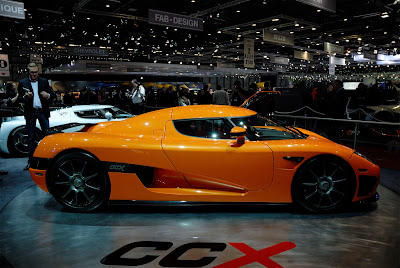
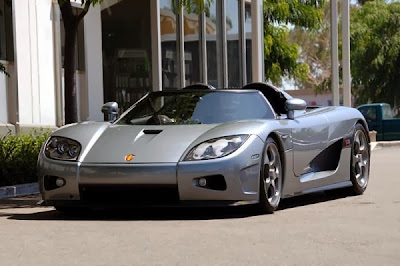
Koenigsegg CCX

Koenigsegg CCX


The Koenigsegg CCX is a mid-engined sports car built by Koenigsegg Automotive AB.  Koenigsegg CCX  the project began with the aim of making a global car, designed and engineered to comply with global safety and environment regulations, particularly to enter the United States car market.[1]To sell cars in the US many alterations were made to the design
of the CCR; the previously used Ford Modular engine was replaced by a Koenigsegg CCX engine designed to run on 91 octane fuel, readily available in the United States, and to meet the Californian emission standards.The name Koenigsegg CCX  is an  abbreviation  for Competition Coupé X, the X commemorating the 10th anniversary (X being the Roman 
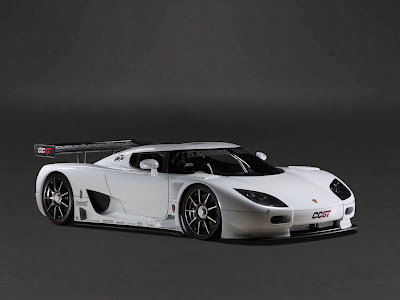

numeral for ten) of the completion and test drive of the first CC vehicle in1996. The  Koenigsegg CCX was unveiled at the 2006 Geneva Motor Show, sporting body modifications to meet US regulations and a new 4.7 L twin supercharged V8 engine capable of producing 806 PS (593 kW; 795 hp) at 7000 rpm and 920 N·m (679 lb·ft) at 5700 rpm of torque while running on 91 octane gasoline. There were 14  Koenigsegg CCX  produced between 2006 and 2010.

KOENIGSEGG CCX
The new engine of Koenigsegg CCX is of all aluminum construction, made out of 356 aluminum with a T7 heat treat to further  Koenigsegg CCX enhance block integrity and cylinder bore chill during casting. Specifically created and cast for Koenigsegg by Grainger & Worrall, a casting specialist with Formul 1
 experience in drivetrain components, the engine is built, assembled and tested at their Ängelholm production plant The Koenigsegg CCX engine is lubricated with a dry sump system with a separate oil pump and the pistons are cooled by means of an internal cooler that sprays oil onto them. Koenigsegg CCX in order to run high cylinder pressure with 91 octane fuel making it capable of 14 mpg (17 l/100 km) in combined cycle and 18 mpg (13 l/100 km) in highway travel.

KOENIGSEGG CCX

Koenigsegg CCX available transmissions are aCima[disambiguation needed] 6-speed manual and a 6-speed automated manual Power is fed to the wheels through a torque-sensitive limited slip differential.Koenigsegg CCX chassis is made from carbon fiber reinforced with kevlar and aluminium honeycomb like previous models and while the body keeps the targa top body style and the "dihedral synchro-helix" actuation doors it is completely reworked, there is a Koenigsegg CCX new front bumper design,
 enhanced brake cooling, fog lamps, US position lights, a new fresh air intake on the bonnet that acts new additional in  Koenigsegg CCX ram air booster, air intakes behind the front wheels to enhance airflow and a glass window over the engine. The Koenigsegg CCX has frontal area of 2,894 sq in (1.867 m2) and a drag coefficient of 0.30. Koenigsegg CCX also has a flat underside with venturi tunnels at the rear and an optional rear spoiler to improve aerodynamics At 200 km/h (120 mph) there is 60 kg of downforce over the front axle and 65 kg over the rear  Koenigsegg CCX car is 88 mm (3 in) longer to comply with the US rear impact regulations and to free space around the rear muffler.  Koenigsegg CCX interior side, there is 51 mm (2 in) of extra headroom as well as specifically designed Sparco carbon fiber seats.i have a good experience with Koenigsegg CCX.


courtesy by http://www.carallmodel.blogspot.com

Peugeot 206

 Peugeot 206


 Peugeot 206
Peugeot 206
The Peugeot 206 is a supermini manufactured by the French automaker Peugeot from 1998 to 2010. Even though the 206 had finished production in most markets by 2010, it was available as the 206+, with front and rear styling that resembles thePeugeot 207, until 2012.


During the early 1990s, Peugeot decided not to directly replace the Peugeot 205, citing the reason that superminis were no longer profitable or worthwhile. Instead, Peugeot followed a unique strategy and decided that its new, smaller, supermini, the Peugeot 106 (launched in 1991) would take sales from the lower end of the 205 range while the lowest models of the Peugeot 306 range, launched in 1993 to replace the Peugeot 309, would take sales from the top-end 205s. Between the 106 and 306, Peugeot hoped that the 205 would not need to be replaced, and could be phased out slowly, while customers who would normally plump for the 205 would continue to have a choice with either a smaller or larger car.
  Peugeot 206


Unfortunately for Peugeot, this strategy did not work. With the 205 phased out, other superminis like the Ford Fiesta and Volkswagen Polo continued to sell well and even increased in popularity, and without a direct competitor to these cars Peugeot was losing sales fast.[citation needed] A new supermini was required, and the 206 was launched in 1998 as a somewhat belated replacement for the 205.

Although the 206 naming indicates a direct continuation from the 205, some critics state that the car should have instead been badged 207. This is because Peugeot launched its latest generation of cars in the early to mid 1990s, with the 106 of 1991, the 306 of 1993 and the 406 of 1995.
  Peugeot 206

Its eventual successor - the Peugeot 207 - was launched in 2006. As of 2010, the twelve-year-old 206 was Peugeot's best-selling car of all time.
It was built in France and England until the end of 2006. The end of British production coincided with the closure of the Rytonplant which Peugeot had taken over when buying Chrysler's European division in 1979.
From April 2010, the Peugeot 206 was no longer listed on Peugeot's current UK model range. LHD production finished in June 2010


courtesy by http://en.wikipedia.org/wiki/Peugeot_206

Aston Martin


Aston Martin


Aston Martin
The 2011 Aston Martin DB9 positions 6 out of 8 One of a kind Activities Vehicles. This position is according to our research of 46 released thoughts and analyze pushes of the Aston MartinDB9, and our research of stability and protection information.


The marketplace likes this year's Aston MartinDB9 because its guiding is accurate, the internal is remarkable, the external delivers exclusivity and it has one of the special journeys in the category.

As a hot elegant motor vehicle, this year's Aston MartinDB9 is up versus hard rivals like the Lamborghini Gallardo as well as Mercedes Florida. For those who look at the Aston MartinDB9’s requirements, you may think that the its highly powerful V12 website gets missing among these versions because their top connections are higher and they produce more power. But car testers say which is just not so. The Aston Martin DB9 preserves its ground because it provides you one factor the Gallardo and Florida don’t: a fine-tuned revocation, Aston Martin car creates a relaxed vacation which is fantastic for lengthy journeys.


Aston Martin


On the other hand, testers say there are a few factors that might get in the way of that journey. Two evaluations, the Aston Martin DB9’s little back seating and little footwear, are common for the category. However, more than one writer says the Aston Martin DB9’s routing is skin challenging to use.

General, evaluators fight don't like theAston Martin DB9. It’s eye-catching, has a relaxed internal and one of the special journeys in the marketplace. "This car was designed, not designed," makes the Detroit Details. "If God required tires, they'd be an Aston Martin DB9 ragtop."

Aston Martin


If you are searching for something more highly effective than the Aston Martin DB9, there are a good amount of alternatives. One is the Lamborghini Gallardo, which may go from zero to 60 in just 3.7 a few moments. The Gallardo also has one of the most relaxed homes in the category, but like the Aston Martin DB9, its touch program can be challenging to use.

$100,000 and up is no little slice of modify, so if you want a tropical fancy car, but never want to pay $200,000 – which is common in this category – there are several alternatives. One is the Mercedes R8. It begins at $114,200, creating it the least costly style in the category. It comes conventional with a 4.0-liter V8 website, which is lesser and generates less power than the Aston Martin DB9’s V12, but testers say the R8 far outshines the the Aston Martin DB9 in the efficiency area. Moreover to a low foundation cost and a highly effective website, the R8 has a relaxed and well-outfitted internal. The Aston Martin DB9 gets a few changes for this year's style season with a new front side components and an current front side grill. It also gets a conventional Flexible Damping Program that quickly tracks revocation tone.The Aston Martin DB9 comes with a V12 web-site which makes 470 energy at 6,000 rpm and 443 pounds-feet of twisting at 5,000 rpm.


Ferrari 458 Spider


Ferrari 458 Spider

Ferrari has released the first official photos of the 2012 Ferrari 458 Spider, the roofless iteration of the mid-engine 458 Italia. Other than losing its lid and gaining some structural enhancements, the Ferrari 458 Spider will be largely identical to its coupe counterpart.Besides shaving the Ferrari 458 Spider’s head,


 Ferrari 458 Spider

Ferrari altered the car’s throttle mapping, suspension tuning, and “engine soundtrack” specifically for topless motoring. The task of dialing in the sound of the Ferrari 458 Spider’s tightly wound 4.5-liter V-8 for
droptop duty seems to us like a two-step process. Step one: Remove roof. Step two: Rev engine. Regardless, the Spider’s soundtrack should be hugely satisfying, produced as it is by the same sonorous 562-hp engine as is used in the 458 Italia. That power is routed through the same seven-speed dual-clutch automatic as is used in the coupe to the same torque-vectoring differential. The Ferrari 458 Spider also inherits the coupe’s F1-Trac traction-control and performance anti-lock-brake system.

Ferrari claims the Spider will run to 62 mph from a standstill in less than 3.5 seconds before romping on to a top speed in excess of 198 mph. In a recent comparison test, we kicked a 458 Italia to 60 mph in just 3.0 seconds, so the Spider’s figure is probably a bit conservative.


Ferrari 458 Spider

Ferrari 458 Spider’s photos—and a video below—put to rest any doubt as to the style of folding roof the Ferrari 458 Spider will use. The car’s mid-engine layout makes a folding roof of any kind difficult to integrate, and after seeing the leaked photos of the car we guessed that only a relatively space-efficient soft top would fit beneath its low-slung tonneau cover. Ferrari, however, cleverly adapted its rotating-roof concept from the 575-based Superamerica to the Ferrari 458 Spider.
The Ferrari 458 Spider’s roof is a bit more complicated than the Superamerica’s rotating lid, and it hides under a double-hump rear deck when stowed (the Superamerica’s roof laid itself on top of the rear deck). Ferrari claims this solution is 55 pounds lighter than a soft top and takes up less space. The roof can fold itself down into a space ahead of the engine bay in 14 seconds, and the independently operable rear window doubles as a wind blocker. Ferrari 458 Spider believes the rear window to be so effective that occupants can converse normally at speeds above 124 mph. The roof mechanism is compact enough that Ferrari 458 Spider was able to keep a parcel shelf behind the rear seats.


Ferrari 458 Spider

To help combat flex, Ferrari did beef up the Ferrari 458 Spider’s chassis to ensure structural rigidity top up or down, but isn’t sharing exactly what it strengthened. The company does, however, claim that the Spider will only outweigh the fixed-roof Ferrari 458 Spider by about 100 pounds. The Ferrari 458 Spider will be on display in Frankfurt in September, and a good part of the production run is likely already spoken for.


courtesy by http://www.caranddriver.com/news/car/11q3/2012_ferrari_458_spider-auto_shows

Bugatti Veyron


Bugatti Veyron

Beyond this suggested checklist, there are a few catches in the procedure that will make it hard to perform a top-speed run on public roads. Once the bugatti Veyron exceeds 35 mph, if you turn the steering wheel more than 90 degrees, or so much as touch the brakes, the car's configuration reverts to the handling ode.Bugatti Veyron  normal mode (top) presents max ride height and a clean body.Bugatti Veyron


 Handling mode (middle) drops the body and extends the rear spoiler and wing. Bugatti Veyron top-speed mode (bottom) hunkers even lower and leaves just a bit of wing showing. When braking in the handling mode, the wing tilts up even more to increase drag and rear downforce.
The reasons for this became clear during my first top-speed lap.Bugatti Veyron With downforce reduced, the Veyron no longer cut through the air like some hyperkinetic fastball. Instead, it meandered slightly, something akin to a swift knuckle ball.

 Bugatti Veyron

I barely touched the Bugatti Veyron car's top-speed governor that was set at 253 mph (407.5 kilometers per hour) on that first lap, but on the second I held the car there for at least three of the back straight's five miles. Bugatti Veyron combination of driveline noise, tire noise, and hurricane-force winds rushing over the car must have been deafening, but I don't remember it, Bugatti Veyron as I concentrated on keeping the gently meandering car within the center of the track's three lanes.
Bugatti Veyron the straightaway was only 32 feet wide, with a low highway-type guardrail at each edge and dense forest beyond. One stretch of the straightaway didn't even have a guardrail on the outside of the track, just a grassy embankment that sloped up at about 20 degrees for about 30 feet toward the trees. Leaving the pavement and ending up in the trees was only a twitch of the steering wheel away.

Bugatti Veyron

Fortunately, the  Bugatti Veyron's steering is ideally set up for such fast running. There's absolutely no slack on-center, and the steering responds with a gentleness that makes it easy to feed in the delicate corrections needed to keep the Veyron between the center lane's dotted lines without overcorrecting. Still, I can see why Bugatti Veyron engineers don't want their customers to be passing semis on the autobahn at 200-plus mph in this low-downforce mode.
When you lift off the throttle at 253 mph, the aerodynamic drag alone slows the Bugatti Veyron at 0.3 g. After running that fast, dropping below 200 suddenly seems utterly effortless. You could not only hold a cell-phone conversation at 185 but also dial a cell phone at that pace. Allocate some money to keep an attorney on retainer if you get one of these cars, because double and triple the speed limit will quickly feel comfortable and normal.
You will likely only experience this speed in short bursts, which is why the Bugatti Veyron's powerful brakes will come in handy. Bugatti Veyron car is equipped with huge carbon-ceramic brakes: 15.7 inches in front with eight-piston, four-pad calipers, and 15.0 inches in back with six-piston, two-pad calipers. When you step on the brakes at high speed, the rear wing tilts up to a 55-degree angle. At 230 mph, this increases rear downforce to 1100 pounds and adds as much as 2500 pounds of drag. A panic stop at that speed produces nearly 2.00 g of initial deceleration—at least 50 percent more retardation than a Porsche 911 can generate at any speed.
Bugatti Veyron with the top speed verified, Schreiber jumped into the car to demonstrate the Veyron's "launch mode," which allows the engine to light up all four tires in a full-bore accel run. He promises the Bugatti Veyron will sprint from rest to 100 km/h (62 mph) in less than three seconds. From this, we would conclude that the car will likely run the quarter-mile in the high 10s at about 140 mph for another production-car record


 courtesy by http://www.caranddriver.com/reviews/car/05q4/bugatti_veyron_16.4-first_drive_review/ultimate_velocity_page_4