Koenigsegg CCX

The Koenigsegg CCX is a mid-engined sports car built by Koenigsegg Automotive AB. Koenigsegg CCX the project began with the aim of making a global car, designed and engineered to comply with global safety and environment regulations, particularly to enter the United States car market.[1]To sell cars in the US many alterations were made to the design
of the CCR; the previously used Ford Modular engine was replaced by a Koenigsegg CCX engine designed to run on 91 octane fuel, readily available in the United States, and to meet the Californian emission standards.The name Koenigsegg CCX is an abbreviation for Competition Coupé X, the X commemorating the 10th anniversary (X being the Roman
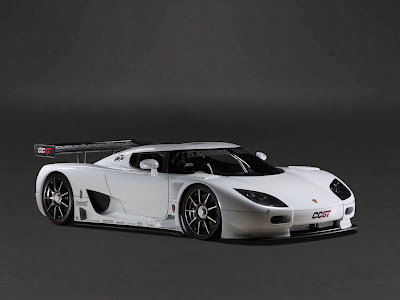
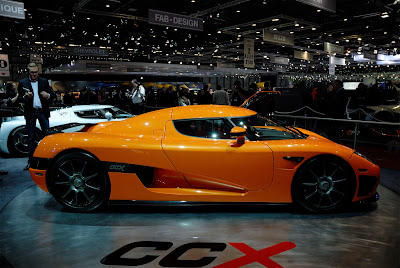
numeral for ten) of the completion and test drive of the first CC vehicle in1996. The Koenigsegg CCX was unveiled at the 2006 Geneva Motor Show, sporting body modifications to meet US regulations and a new 4.7 L twin supercharged V8 engine capable of producing 806 PS (593 kW; 795 hp) at 7000 rpm and 920 N·m (679 lb·ft) at 5700 rpm of torque while running on 91 octane gasoline. There were 14 Koenigsegg CCX produced between 2006 and 2010.
of the CCR; the previously used Ford Modular engine was replaced by a Koenigsegg CCX engine designed to run on 91 octane fuel, readily available in the United States, and to meet the Californian emission standards.The name Koenigsegg CCX is an abbreviation for Competition Coupé X, the X commemorating the 10th anniversary (X being the Roman

numeral for ten) of the completion and test drive of the first CC vehicle in1996. The Koenigsegg CCX was unveiled at the 2006 Geneva Motor Show, sporting body modifications to meet US regulations and a new 4.7 L twin supercharged V8 engine capable of producing 806 PS (593 kW; 795 hp) at 7000 rpm and 920 N·m (679 lb·ft) at 5700 rpm of torque while running on 91 octane gasoline. There were 14 Koenigsegg CCX produced between 2006 and 2010.
KOENIGSEGG CCX

 experience in drivetrain components, the engine is built, assembled and tested at their Ängelholm production plant The Koenigsegg CCX engine is lubricated with a dry sump system with a separate oil pump and the pistons are cooled by means of an internal cooler that sprays oil onto them. Koenigsegg CCX in order to run high cylinder pressure with 91 octane fuel making it capable of 14 mpg (17 l/100 km) in combined cycle and 18 mpg (13 l/100 km) in highway travel.
KOENIGSEGG CCX
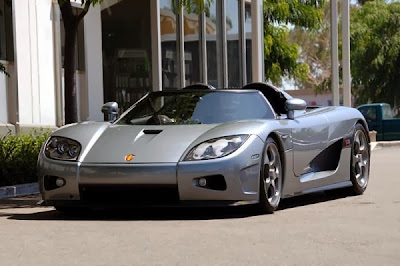
 Koenigsegg CCX available transmissions are aCima[disambiguation needed] 6-speed manual and a 6-speed automated manual Power is fed to the wheels through a torque-sensitive limited slip differential.Koenigsegg CCX chassis is made from carbon fiber reinforced with kevlar and aluminium honeycomb like previous models and while the body keeps the targa top body style and the "dihedral synchro-helix" actuation doors it is completely reworked, there is a Koenigsegg CCX new front bumper design,
 enhanced brake cooling, fog lamps, US position lights, a new fresh air intake on the bonnet that acts new additional in Koenigsegg CCX ram air booster, air intakes behind the front wheels to enhance airflow and a glass window over the engine. The Koenigsegg CCX has frontal area of 2,894 sq in (1.867 m2) and a drag coefficient of 0.30. Koenigsegg CCX also has a flat underside with venturi tunnels at the rear and an optional rear spoiler to improve aerodynamics At 200 km/h (120 mph) there is 60 kg of downforce over the front axle and 65 kg over the rear Koenigsegg CCX car is 88 mm (3 in) longer to comply with the US rear impact regulations and to free space around the rear muffler. Koenigsegg CCX interior side, there is 51 mm (2 in) of extra headroom as well as specifically designed Sparco carbon fiber seats.i have a good experience with Koenigsegg CCX.




courtesy by http://www.carallmodel.blogspot.com