Showing posts with label jeep cherokee. Show all posts

Jeep Cherokee

Jeep Cherokee


Jeep Cherokee


In their original incarnation, SUVs were chiefly owned by folks who valued "utility" above "sport." A four-wheel-drive, station wagon-like vehicle was just the thing to transport five (or more) adults to remote areas, handle bad-weather driving or pull heavy trailers.

[youtube]dum5Or1L1L8[/youtube]Trouble was, they required the skill of a limo driver to park in the city and a gas card with a generous limit to keep them moving. Consumers who wanted something more reasonable in terms of size and fuel usage were out of luck.
That changed with the 1984 arrival of the Jeep Cherokee. Though there was a trim level of the '70s-era full-size Wagoneer called Jeep Cherokee, this new model was completely different. Its compact dimensions, unibody (as opposed to heavier body-on-frame) architecture and classic styling made this junior Jeep an immediate success.
The Jeep Cherokee was discontinued when Jeep introduced the Liberty, but even on the used market, it remains one of Jeep's most popular products. With minimal changes, it had a nearly 20-year production run, and plenty of Jeep Cherokees are still on the road today. Jeep Cherokee many have been modified with the usual off-roading upgrades, such as bigger tires, brush guards and lifted suspensions.
Although the Jeep Cherokee's relatively tidy dimensions make it great for negotiating a tight trail, dicing with rush-hour traffic and parallel-parking, there are some sacrifices made for this nimble nature. Jeep Cherokee Getting in and out is tricky due to the high step-up and small doors, and the rear seat is cramped. Nor is this Jeep Cherokee particularly refined. Shoppers interested in a late '90s or early 2000s small SUV for mostly urban runabout duty might be happier with car-based competitors (Honda CR-V, Toyota RAV4) of similar vintage.

Jeep Cherokee


It would probably take the most devout Jeep enthusiast to tell a second-generation (1997-2001) Jeep Cherokee from the first. Exterior changes were subtle -- essentially a smoothing of the nose and corners and new taillights. A Jeep Cherokee revised cabin sported a new dashboard with dual airbags, though ergonomics were still hit or miss and storage space was minimal. Trim levels initially stood pat at base SE, midgrade Sport and upscale Country. By the end of this generation's run, the Country was dropped, with the Classic and Limited slotting above the Sport.
Jeep Cherokee Powertrain choices included a 2.5-liter inline-4 (125 hp) and a 190-hp, 4.0-liter inline six-cylinder engine. Jeep Cherokee four-cylinder, Jeep offered either a five-speed manual or three-speed automatic. The larger engine could be paired with a five-speed manual or four-speed automatic. One could have rear- or four-wheel drive, and there were two 4WD systems to choose from: part-time "Command-Trac" or full-time "Selec-Trac."
In our road test of a '97 Jeep Cherokee, we found the Jeep unequalled off-road while still providing respectable performance on the blacktop in terms of acceleration and handling. We liked the firm, sporty ride, although some people may find it too stiff, judging by our consumer feedback.
Owner comments indicate that a more recent Jeep Cherokee should be a reliable workhorse as powertrains are sturdy, though brake rotors are known to warp and need replacement. We recommend a thorough inspection by a trusted mechanic before considering a purchase.

Jeep Cherokee 


The first-generation Jeep Cherokee ran from 1984-'96. Two- and four-door versions were available. As both were built on a short 101.4-inch wheelbase and weighed approximately 3,100 pounds, the Cherokee was lithe compared to the Ford Broncos and Chevy Suburbans of the day.
It was a good thing the Jeep Cherokee was relatively light, as the initial power choices consisted of a 2.5-liter inline-4 with just 105 hp or a 2.8-liter V6 (which was sourced from Chevrolet) Jeep Cherokee made only 115 hp. There was also a turbodiesel available, though it proved unpopular. Jeep Cherokee Transmission choices included a three-speed automatic and four- and five-speed manuals. Trim levels included base, well-equipped Pioneer and sporty Chief. Two- and four-wheel-drive versions were offered, the latter available in either part-time Command-Trac or full-time Selec-Trac configuration.
For 1987, power increased substantially, as the Jeep Cherokee received a new 4.0-liter inline-6 that made 177 hp while the inline-4 was boosted to 121 hp. Jeep Cherokee six-cylinder versions, a four-speed automatic replaced the outdated three-speed unit. By this time the trims were shuffled and now included the midlevel Laredo and plush Limited, the latter sporting gold mesh wheels and pinstripes. Power increased again in 1991, with the four making 130 hp and the much more popular six pumping out 190 hp. By the time this generation ended in 1996, engine refinements made for smoother, quieter operation.


courtesy by http://www.edmunds.com/jeep/cherokee/


Jeep Grand Cherokee SRT8 2011

Jeep Grand Cherokee SRT8 2011

Jeep Grand Cherokee SRT8 2011


The big and bold  Jeep Grand Cherokee SRT8 2011 made its debut today at the New York Auto Show. To be honest, this tire-melting and Hemi-powered SUV seemed a little out of place in a show dominated by small cars and boasts about fuel-efficient engineering. It’s not going to save the earth, but the Jeep Grand Cherokee SRT8 2011 does have plenty of guilty pleasures under its blocky body.

The Jeep Grand Cherokee SRT8 2011 is sports a more aggressive front and rear fascia—to differentiate itself from less powerful models—and an intimidating pair of 4-in. tailpipes. Jeep Grand Cherokee SRT8 2011 try as we might, there was no coercing a Jeep rep to crank the engine so we could hear those monster pipes in action.


Jeep Grand Cherokee SRT8 2011


Jeep Grand Cherokee SRT8 2011 a larger grille, redesigned foglights and bigger front air intakes give the SRT8 extra attitude—even though the journalists at the New York show seemed especially enamored by the functional hood vents. Jeep Grand Cherokee SRT8 2011 Flared wheel arches and 20-in. alloy wheels round out the exterior modifications. Inside, the Jeep Grand Cherokee SRT8 2011 has heavily bolstered leather and suede sport seats, carbon-fiber trim on the instrument and door panels, and paddle shifters on the steering wheel.Jeep Grand Cherokee SRT8 2011 the 420-bhp 6.1-liter V-8 is gone, replaced by a larger and more powerful 465-bhp 6.4-liter Hemi V-8. There is permanent in Jeep Grand Cherokee SRT8 2011 4-wheel drive (Quadra-Trac, in Jeep speak), a 5-speed automatic, and a tow rating of 5000 lb. If you’re really in a hurry while trailering those jet skis, Jeep says the Jeep Grand Cherokee SRT8 2011 pulls 0.90g on the skidpad. What’s more, Jeep says the new Jeep Grand Cherokee SRT8 2011is the “best handling Jeep ever.”

Jeep Grand Cherokee SRT8 2011


Jeep Grand Cherokee SRT8 2011 stability control, an electronic limited-slip differential and adaptive damping (managed by the Selec-Trac system) should give the Jeep Grand Cherokee SRT8 2011 the road manners to match its prodigious straight-line performance. And believe us; Jeep was more than happy to let journalists know the performance specs of the new Jeep Grand Cherokee SRT8 2011. Clearly, the “best performing” Jeep ever built means it’s also the fastest.
The sprint to 60 mph takes only 4.8 seconds. Top speed is electronically limited to 155 mph. And the quarter mile is dispatched in the mid-13s, according to Jeep. Massive 6-piston Brembo calipers (front) haul the SRT8 from down from 60 mph in only 116 ft.
About the only figure Jeep didn’t provide us with was the price. We’ll find that out when the new 2012 Jeep Grand Cherokee SRT8 goes on sale in the fall


COURTESY BY http://www.roadandtrack.com/auto-shows/new-york/2012-jeep-grand-cherokee-srt8

JEEP PATRIOT

Jeep Patriot

Jeep Patriot


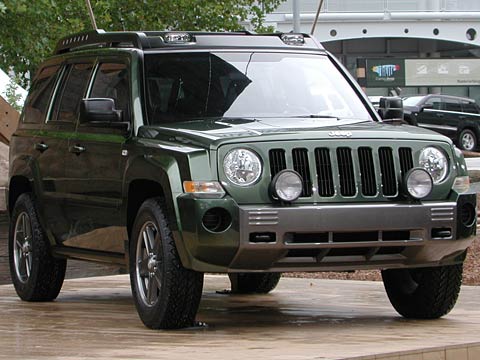
The Jeep Patriot (MK74) is a compact crossover SUV introduced in early 2007 for the 2007 model year by the Jeep marque of Chrysler. It debuted publicly in April 2006 at the New York Auto Show and slots between the Compass and Liberty in the Jeep Patriot lineup. Market-wise, it is the least-expensive SUV in North America and one of the cheapest SUV-standard crossovers up to date.


The Compass and Jeep Patriot are both based on the DaimlerChrysler/Mitsubishi GS platform. These Jeep Patriot vehicles are differentiated by their styling and marketing: The Jeep Patriot is a traditionally styled 4-door Jeep wagon, while the Compass shares a more in-town hatchback look, similar in terms to the Dodge Caliber.In a press conference on November 4, 2009, Chrysler LLC, now 20% under Fiat ownership, announced that both the Jeep Patriot and Compass would get modifications for 2010, but will be discontinued by 2012, to be replaced by a single Fiat-based model.

Jeep Patriot

The Jeep Patriot and Compass are both based on the DaimlerChrysler/GS platform. These vehicles are differentiated by their styling and marketing: The Jeep Patriot is a traditional four-door Jeep wagon, similar to the Cherokee, which was discontinued in the U.S. in 2001, while the Jeep Patriot Compass is intended as a sporty crossover, but with more capacity to handle rough roads and poor weather than competitors like the Pontiac Vibe. The Dodge Caliber, also based on the GS platform, is a more direct competitor to the Pontiac Vibe and Toyota Matrix, and is more like a small hatchback than either of the Jeeps. The Jeep Patriot is manufactured at DaimlerChrysler's Belvidere, Illinois assembly plant alongside the Dodge Caliber and Compass.The Jeep Patriot uses a four-cylinder 2.0L or 2.4 L GEMA gasoline I4 engine Jeep Patriot In the US The base car features front-wheel drive, In Jeep Patriot choice of two electronically-controlled four-wheel drive systems is optional. One, the Freedom Drive I, is a full-time system for on-road use. Freedom Drive II in Jeep Patriot is made for off-road use with variable torque between speeds of 25 mph (40 km/h) and 65 mph (105 km/h) for optimal handling. The 2.0 L GEMA I4 is an option for the 4X2 model Patriot.
For Europe and Australia a 2.0 L (1968 cc; 120 cid; 140ps) Volkswagen-manufactured diesel engine is fitted along with a 6-speed manual gearbox. All EU cars are fitted as standard with four wheel drive and a version of the Freedom Drive System which tuned differently from the USA versions but with similar capability to FDII with brake traction control and three switchable electronic stability control and traction control settings for on or off-road use.

Jeep Patriot

Jeep Patriot is the Freedom Drive II-equipped Jeep Patriot uses a continuously variable transmission with a low range instead of a traditional two-speed transfer case, but has Jeep's "Trail Rated" badging, signifying that it "Jeep Patriot has been designed to perform in five categories of off-road conditions: traction, ground clearance, maneuverability, articulation, and water fording." The Freedom Drive II Jeep Patriot is among the most offroad-capable vehicles in its class, thanks in part to the presence of the off-road Brake Traction Control which is also available in Freedom Drive I options. This allows the vehicle to maintain forward motion if one or two wheels lose traction by selectively applying brakes to the spinning wheels. This is a major improvement over a conventional AWD system; a vehicle intended for onroad use with open differentials only would be stranded if there is a loss of traction in one front and one rear wheel at the same time.

jeep-patriot-back_450


 courtesy by http://en.wikipedia.org/wiki/Jeep_Patriot